.png)
Commercial Touchless Faucets: Sourcing & Smart B2B Solutions

For airports, hospitals, shopping malls, and office buildings, restroom equipment must support hygiene, water efficiency, durability, and facility management. This is why touchless restroom faucets have become a practical upgrade for high-traffic environments.
This guide explains how automatic restroom faucets operate, why high-traffic facilities are shifting to hands-free solutions, and what B2B buyers should check before sourcing.
How Do Automatic Restroom Faucets Operate?
An automatic restroom faucet is designed to activate water flow only when a user’s hands are detected within the sensor range. It will send a signal to the control module, which opens the internal solenoid valve and allows water to flow. Once the hands move away, the sensor stops detecting motion, and the solenoid valve closes to shut off the water.
This system is supported by several internal components working together :
Behind the faucet body, the sensor module identifies the presence of hands.
The solenoid valve controls the opening and closing of the water supply.
The power module provides energy to the sensor and valve system.
Depending on the product design, the faucet may be powered by batteries, a hardwired electrical connection, or a plug-in adapter. Some commercial models may also include mixing valves, temperature control components, flow restrictors, filters, or control boxes for easier maintenance.
Why High-Traffic Facilities Are Shifting to Hands-Free Solutions
The shift toward hands-free restroom fixtures is not only a design trend. It reflects practical needs in public health, resource efficiency, and facility maintenance.
Elevating Hygiene and Health Standards
An automatic restroom faucet reduces the need for physical contact, removing the cross-contact potential of traditional faucet handles. This supports infection-control practices in hospitals and clinics, while creating a more premium, user-friendly impression in commercial spaces like hotels and offices.
Water Conservation and Cost Efficiency
Automatic sensor faucets help control water use by dispensing water only when needed and shutting off automatically. For B2B buyers, this water conservation translates directly to cost efficiency. Facilities with heavy traffic see meaningful savings, which also supports green building goals and ESG initiatives.
Minimizing Wear and Vandalism
Touchless restroom faucets reduce physical contact, which lowers mechanical wear on external components. Commercial sensor faucets are often designed with stronger bodies and vandal-resistant structures. For facility maintenance teams, fewer touchpoints mean fewer repairs, handling continuous use in public environments without frequent failure.
Further Reading: Commercial Bathroom Design in 2026: Trends and B2B Solutions
The B2B Buyer’s Checklist: Selecting Heavy-Duty Sensor Faucets
For commercial buyers, the procurement often involves project scale, installation conditions, compliance requirements, maintenance planning, and brand customization. Before placing an order, buyers should evaluate several key specifications.
Choosing the Right Mounting Style
Deck-Mounted: Installed directly on the sink deck or countertop, these are widely used in commercial restrooms, office buildings, and shopping malls.
Wall-Mounted: Installed on the wall above the sink, creating a cleaner countertop and modern architectural appearance for design-focused spaces and healthcare environments.
Checking Power Configurations
Battery-Powered: Flexible and convenient for retrofitting existing restrooms without requiring new electrical wiring.
Hardwired: Connected directly to the building’s electrical system, ideal for new construction to reduce battery replacement in facilities with many faucets.
Plug-In: Uses an adapter connected to a nearby power outlet, offering a practical middle option depending on layout.
Ensuring Industrial-Grade Durability
For the US market, it is crucial to source products that meet strict regulations:
ASME A112.18.1/CSA B125.1 for plumbing fixture fittings.
NSF/ANSI/CAN 372 and NSF/ANSI/CAN 61 for lead-free compliance and drinking water safety.
In addition, salt spray testing helps evaluate corrosion resistance for humid environments, while coating thickness reports confirm if the finish meets durability standards for long-term commercial use.
Further Reading: Lead Free Faucet Guide: 5 Rules Every Homeowner Should Know
Beyond the Faucet: Building a Smart Restroom Ecosystem
Designing a modern commercial facility requires looking past individual fixtures. To achieve the standards of sanitation and resource management, public environments are expanding their focus from installing a single automatic restroom faucet to constructing a comprehensive smart restroom ecosystem.
Integration with Automatic Soap Dispensers
Pairing touchless restroom faucets with automatic soap dispensers creates a complete hands-free washing experience. Sourcing both fixtures from the same manufacturer improves the visual consistency of the restroom and simplifies installation planning.
Further Reading: The Ultimate Guide to Commercial Auto Soap Dispensers for Restrooms
Leveraging IoT for Facility Management
Smart restroom technology can help facility teams monitor usage patterns, water consumption, battery status, and potential fixture issues. Instead of waiting for complaints, managers can proactively identify abnormal water usage or low batteries, reducing downtime in large facilities like airports and corporate campuses.
Partner with a Trusted Manufacturer: Custom OEM/ODM Solutions
For commercial projects, sourcing the right automatic restroom faucet is only part of the process. Buyers also need a reliable manufacturing partner that can support product development, quality control, customization, testing, and delivery.
This is where a specialized manufacturer like Chang Yi Shin (TAP) comes in. With over 50 years of precision component experience, TAP’s strong in-house design-to-manufacturing capabilities allow the team to support product planning, engineering review, tooling, production, assembly, testing, surface finishing, and quality inspection. This comprehensive approach helps B2B buyers reduce communication gaps and improve project efficiency.
For buyers seeking touchless restroom faucets, several TAP faucet models can be considered for different project requirements:
Faucet Model | Key Features & Target Applications | |
 | Suitable for commercial projects that require a clean, practical, and reliable sensor faucet design. | |
 | Offers an option for projects that need a modern automatic restroom faucet with stable performance and a professional look. | |
 | Supports projects that require a stronger visual presence or a more specific faucet profile. | |
 | Provides a solution for buyers looking to expand their commercial sensor faucet product line or source customized models for different types. |
Rather than just taking orders, TAP focuses on identifying and solving the critical core problems of your specific project. Whether you require customized sensor ranges, unique faucet profiles, or specific power configurations, our team works closely with you to ensure the final product precisely matches your exact requirements and application scenarios.
TAP is also able to provide rigorous inspection processes, testing reports, production traceability, and technical communication to ensure that products meet project expectations. By leveraging our co-design process, B2B buyers can create overall operational benefits that exceed expectations.
Contact us today to discuss your OEM/ODM project requirements and build a smarter, more efficient restroom ecosystem.
FAQs
Q. Do touchless restroom faucets really save water?
Yes, they save water by turning on only when hands are detected and shutting off automatically when the user moves away. This reduces the chance of water being left running.
Q. What is the best power source for commercial sensor faucets?
It depends on the project. Battery-powered faucets are flexible for renovations, hardwired faucets suit new constructions aiming to reduce maintenance, and plug-in models are useful when outlets are available.
Q. Are automatic sensor faucets difficult to maintain?
No, they are not difficult to maintain when designed for commercial use. Regular maintenance simply includes checking the sensor area, cleaning the aerator, and inspecting the power supply.
Further Reading:
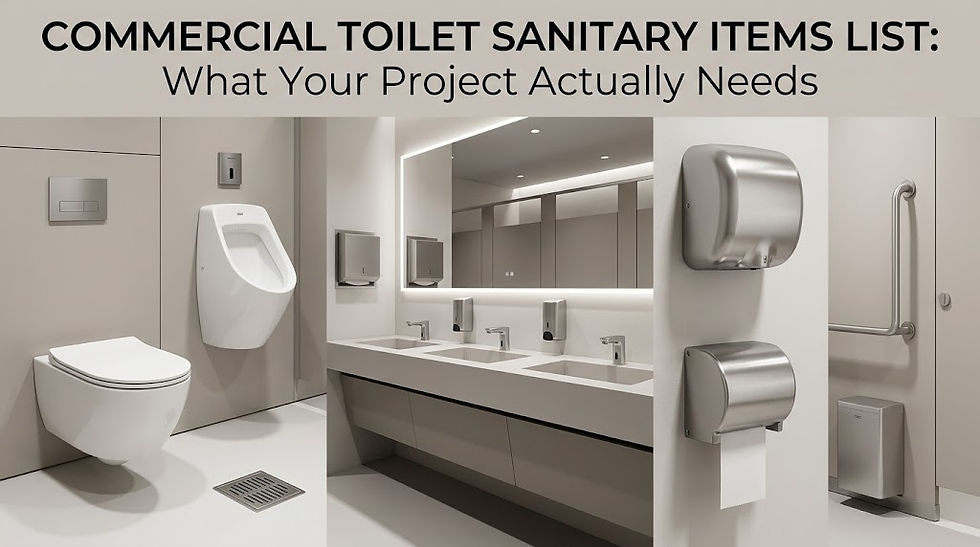
Commercial Toilet Sanitary Items List: What Your Project Actually Needs
Public Restroom Faucets: Types, Specs, and Hygiene Benefits